
Air Quality Testing and Analysis Services
Pace® provides air quality testing and analysis across the full range of air sampling programs: indoor air quality, ambient air, fenceline and perimeter monitoring, meteorological permit monitoring, stack and source emissions, and vapor intrusion and soil gas. Samples are analyzed to published EPA, NIOSH and OSHA methods and reported with the documentation your permit, remediation plan or building assessment requires.
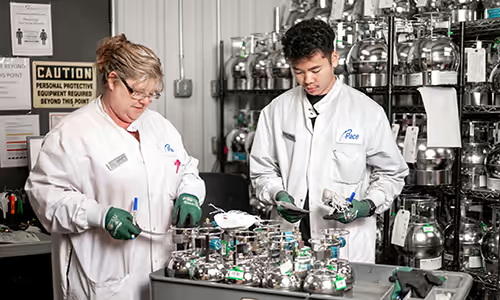
The Pace® Air Center of Excellence is the largest air laboratory testing facility in the United States, backed by one of the largest air sampling media inventories in the country.

Indoor Air Quality Testing
Indoor air quality testing at Pace® covers volatile organic compounds by EPA Method TO-15, polycyclic aromatic hydrocarbons and PCBs by EPA Methods TO-4, TO-10 and TO-13, and mercury by NIOSH Method 6009M. Sampling is performed with evacuated canisters, PUF cartridges or sorbent tubes depending on the compound, the duration and the detection limit your project requires.
Canisters are available in 1L, 1.4L, 3L and 6L sizes, with flow controllers and restrictors that support collection periods from five minutes to seven days. Contact the laboratory before you sample. Indoor air investigations in older buildings often include asbestos air testing by PCM and TEM.
Ambient Air and Perimeter Monitoring
Ambient air and perimeter monitoring measure what is in the outdoor air around a facility or site, rather than inside a building. Pace® supports fenceline and perimeter monitoring and meteorological permit monitoring for facilities operating under state or federal air permits. To measure what a stack, vent, or other point source is releasing directly, see our stack and source emissions testing.


Vapor Intrusion and Soil Gas Testing
Vapor intrusion and soil gas testing measure volatile chemicals moving from contaminated soil or groundwater into the air inside a building. These assessments typically run under state cleanup programs, sampling sub-slab, soil gas, and indoor air with evacuated canisters or sorbent tubes. Samples are analyzed for volatile organic compounds by EPA Method TO-15 with fixed gases available by ASTM D1946 or 3C.
Who Needs Air Quality Testing
Air quality testing is requested by industrial hygienists and building professionals investigating indoor air complaints, environmental consultants running vapor intrusion and soil gas assessments under state cleanup programs, facilities operating under Title V or state air permits, and property owners and school districts responding to occupant health concerns.

Air Testing Reports and Turnaround
Reports identify the method, compounds of concern, concentrations, reporting limits, and any analytical anomalies. Sampling media is shipped from the Pace® distribution network before your sampling event, and return shipping to our Air Center of Excellence is included with the media order.
Need it fast? Contact your nearest laboratory to confirm available media and analytical turnaround.
Air Sampling Equipment and Flow Measurement
Indispensable for critical applications—from air permitting to meteorological monitoring.
Discover the Pace® Streamline Family—Engineered for Excellence, Designed for You.
Pace® Air Center of Excellence
Pace® Air Center of Excellence is the largest air lab testing facility in the country. Through this centralized model, we have the unique ability to bring together professionals with deep air testing and analysis experience. All the while, adding significant capacity to address a variety of needs.
In addition, Pace® Air Center of Excellence delivers thought leadership, best practices, research and development, and support. We focus on our customers’ challenges and air testing needs. Therefore, by combining the skills of air professionals from a range of disciplines, we are better able to offer broad subject matter expertise that contributes to superior customer outcomes. Added benefits include our ability to optimize resources, increase efficiency, maximize ESG initiatives, and deliver exceptional performance.
Importantly, for Pace® customers, this translates to:
- Increased capacity to meet demand with the largest collection of sampling media and setups
- New distribution centers in the network to efficiently pick up/drop off and route sampling media
- Quick access to the right expertise at the right time
- Faster results by increasing the speed of delivery, development, and continuous improvements to testing processes
- Consistent, high-quality data and a superior end-to-end customer experience
Air Sampling Media and Canisters
At Pace®, we maintain one of the largest air sampling media inventories in the United States. This includes several thousand flow controllers and restrictors to meet your Air Quality Testing needs. Depending on the canister size, a flow controller or restrictor can be integrated to allow a collection time of 5 minutes to 7 days.
- Quick Disconnect Canisters (1.4L, 6L)
- Standard Canisters (1L, 2.7L, 3L, 6L)
- VCO Adapters for more leak free connections
- Flow Controllers and Restrictors
- Sampling Bags
- Purge Manifolds
- Radiello 130 tubes

Air Sampling Tutorials and Technical Videos
How to Leak Check a Canister
Learn how to leak check an air canister before starting indoor air quality testing or ambient air sampling. This step‑by‑step guide covers everything from 1‑liter canisters for soil gas and sub‑slab work to 6‑liter canisters for environmental testing and air monitoring.
High Volume Sampling for PCB Methods
In this video, our own Andy Rezendes demonstrates how to process puff cartridges for air sampling of PCBs, supporting EPA methods TO-4, TO-13 and TO-10.
How to Troubleshoot Digital Gauge for Air Sampling
Discover how to troubleshoot digital gauges. From power failures to moisture damage, learn how to quickly diagnose issues to ensure accurate and reliable sampling results.
NIOSH Method 6009: Air Sampling for Mercury
Sampling for mercury with sorbent media? This step-by-step video tutorial details preparing gold-coated sorbent tubes, setting up the air sampling pump, and more.
Additional Air Testing Resources
-
Pace® Environmental Certifications
-
Pace® Environmental Emergency Response
-
Related Pages
-
Downloadable Resources
-
On-Demand Webinars
Need to find a lab that can handle your unique requirements?
Contact us directly or download our list of environmental certifications across our network.
When disaster strikes, the Pace® Environmental Emergency Response Team is here to help you act fast.